
Thoughts on my Kitchen Calendar
How Kitsch Helped Solve a Gospel Riddle

For two or three years in a row, I bought a wall calendar for the kitchen with a different Bible verse on each month. I kind of enjoyed reading the verse when I turned the page every thirty days or so, but the pictures always bothered me. You’d think you’d be able to get a Bible calendar decorated with great paintings from the Renaissance or something, but no. Every easily available calendar with Bible verses on it was illustrated by the cheesiest nature photography you could imagine. A river in a forest. Wildflowers in a glen. Sunrise over the mountains. Anodyne was the adjective that always came to mind, defined as, “Weakened or made bland, as to avoid harm or controversy.”
The only exception was the year I broke down and bought a calendar illustrated by Thomas Kinkade, the self-proclaimed “painter of light.” I hoped this would at least be decorative, but it was even worse. Kinkade’s twee, sentimental fantasies of English country cottages made me feel like I was imprisoned in one of those Hallmark Christmas specials that now seem to play on Netflix all year long. No wonder Kinkade drank himself to death.
Now, in general, I don’t spend a ton of time thinking about my kitchen calendars, but I did ponder this phenomenon on occasion. Why should a calendar with verses from the Bible — a book that addresses every aspect of life — be illustrated only with pictures that border on smiley-faced kitsch? In the end, honest fellow that I am, I realized that I had to take some measure of responsibility for this.
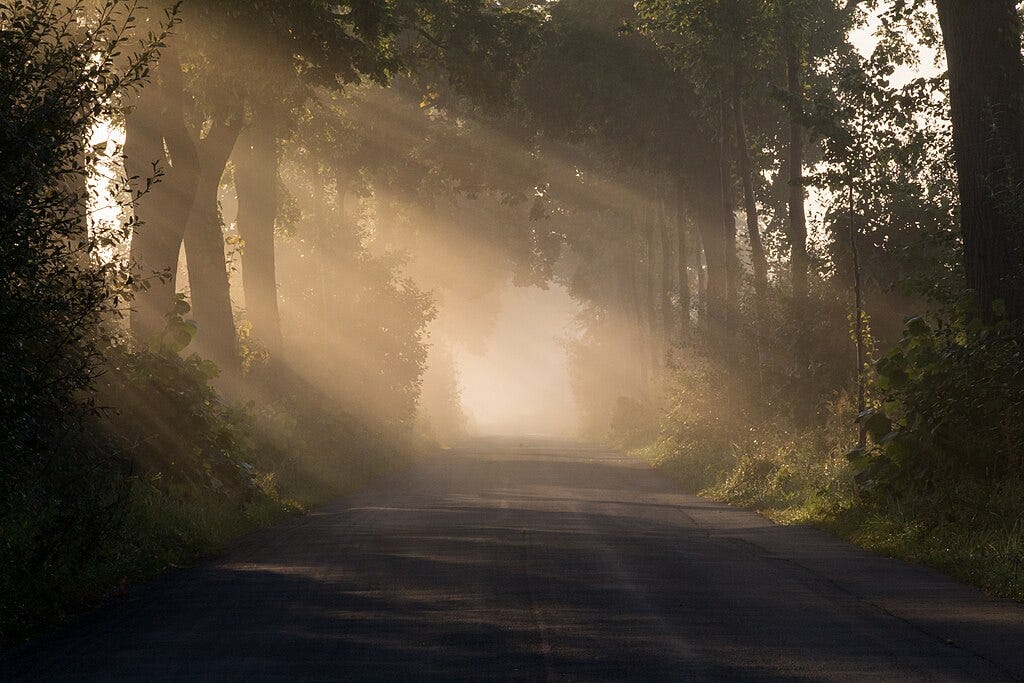
Because, in truth, one doesn’t buy a Bible verse calendar in the expectation that he will turn over a new month and find some depressing cry of despair decorated by a picture of the Babylonian exile or the crucifixion. You’re looking to start the month with a bit of solace and encouragement. Something like: “Weeping may endure for a night, but joy comes in the morning,” as opposed to “Behold, I will bring evil upon thee, and will take away thy posterity, and will cut off from Ahab everyone that pisseth against a wall.”
In short, every time I bought a new kitchen wall calendar, I was opting for Happy Think. I was starting the year by embodying everything I hate about modern Christianity, what Schopenhauer called its “banal optimism.” I had always believed in “a God of the sad world,” a world where the incarnation of the creator appeared amidst his creation only to be tortured, mocked and crucified. But here, I was snipping that reality out of the narrative in order to create a faith narrative that looked like a string of paper dolls: one jolly faceless figure after another with all the tragedy trimmed away. To put it bluntly, I was betraying all my principles. And it wasn’t even February yet.
Of course, it has not escaped my notice that my sad, uncertain version of Christianity is not the most popular version, not by a long shot. For some reason I can’t begin to explain, people don’t actually turn to the Bible in their hours of need in order to have the Solomon of Ecclesiastes remind them that everything is meaningless vanity. They want something more like, “’I know the plans I have for you,’ declares the Lord, ‘plans to prosper you and not to harm you, plans to give you hope and a future.’”
Is that so wrong?
Well, I’ll tell you. The other day, I was standing at my workroom window. I looked out at the frozen river glimmering in the sun, and watched the children sledding down a nearby hill while dogs tumbled hilariously through the snowbanks. And it occurred to me how like a cheesy illustration from a Bible calendar it was, and how lovely it was too. In fact, it is often when I contemplate such scenes of peace and play and natural beauty that I feel the presence of God and sense the pattern of his Logos.
But it’s not only such scenes that inspire my faith. Terrifying storms and catastrophes can have a beauty to them too. Sere wilderness and lowering mountains that overawe the mind can remind us of that God whom to fear is the beginning of wisdom.
But this is true if, and only if, we are watching these sublimities from afar. When the lightning strikes us, when the wilderness swallows us, when the catastrophe falls on us or on those we love — then the revelation tends to vanish, the inspiration fades, and sometimes our faith dwindles away as well. Pain and suffering and ultimately death can strip us of our sense of creation’s beauty and benevolence and make us run to our wall calendars for some comforting verse, false and dishonest though it might be when taken out of context.
And why not? The existential facts of life are weighted, after all, toward bleakness. We hope for heaven, but we are absolutely certain of death. And no matter how many of our prayers in life are answered, our joys are fleeting, while death, for all we know for sure, goes on and on and on.
Oddly, this reflection, typical of my sunny disposition, solved an old riddle for me. Why did Jesus heal people? Why did he bring the dead back to life? What was the point of it? The healed would just grow sick again. The resurrected would someday die. What was the purpose of giving the blind man his sight and the lame man his legs if they would lose them finally forever in the grave?
It must be, I realized, that Jesus saw the world far differently than we do. He saw that the things we experience as most real — suffering and death — are actually illusions, and the things that we fear are illusory — our souls and our eternal life — are in fact the most real. If what he saw is true, if it’s our pain that passes and our joy that lasts, if it’s our life that is endless and our death that dies, then all the world is beauty, and it’s not sentimental in the least to see it as it truly is. If, through healings and resurrections, Jesus could teach us to see what he saw, his joy would be in us and our joy would be complete.
But can we see like that? Do we? It certainly seems that some few of us do. For the vast rest of us — for me certainly — it’s more a case of hints and glimpses, hopes and yearnings. “I believe. Help me in my unbelief!”
The important thing — for me anyway — is neither to pretend nor to despair. To pretend to see beyond fear and doubt — that’s pious sentimentality at its worst. It is a Thomas Kinkade painting of faith, not faith itself. But to believe because the facts trend toward mystery, because some logic of the soul’s connection with the world whispers of eternity — to strive in hope to see what you believe despite your fear — that is the noble struggle of religion, the defiant step forward into the darkness of doubt in search of that peace that passes understanding.
Because it is rational to hope that when, or if, we come to know what Jesus knew and see what Jesus saw, our minds will be transformed. We will have broken out of our calendar cocoon into a clarity far lovelier than any comforting delusion. We will have journeyed beyond the valley of the shadow into a new heaven and earth, from which this old, fallen, death-riddled relic will at last have passed away.
“ But to believe because the facts trend toward mystery, because some logic of the soul’s connection with the world whispers of eternity — to strive in hope to see what you believe despite your fear — that is the noble struggle of religion, the defiant step forward into the darkness of doubt in search of that peace that passes understanding. “. This went straight to my heart…you captured my feelings exactly. “Lord, I believe; help my unbelief”…..and, it is so much more profound than sweet paintings!
I read and reread the sentence, “But to believe because the facts….that passes understanding.” It struck me as a brilliant and near perfect description of the road of faith. My brain does process certain facts and my soul indeed whispers all into an opaque landscape that I “believe” will become clear and lovely later. Thank you Andrew.