
Unidentified Flying Angels
What are men prepared to see in the sky?

It may be Steven Spielberg was born for such a time as this. He’s been telling fantasy tales of alien visitation throughout his career—E.T., Super 8, Close Encounters of the Third Kind. But his latest, Disclosure Day, will drop right as extraterrestrials are becoming a real-life going concern as they haven’t been since the ’60s and ’70s. President Trump spent the month of May declassifying images of UAPs (“Unidentified Anomalous Phenomena”, formerly UFOs). Podcasters and true believers have basically been running free promotion for Spielberg’s movie, which is about exactly this kind of thing, ever since.
The matter of outer space is of renewed interest to the general public for another reason, too. Back in March, Vice President J.D. Vance floated the idea that what’s out there might be not aliens, but demons. Just last week, the Catholic archbishop of Washington, D.C. removed a priest from his post as an exorcist after he suggested basically the same thing: “It’s my personal belief,” said Monsignor Stephen Rossetti, “that probably many if not most of these UFO sightings are in fact demons.”
Here, for the record, are my own presuppositions. I’m highly prone to suspect that there are conscious beings in outer space, and highly skeptical of any given person’s claim to have encountered one. Extraterrestrial life wouldn’t pose much of a challenge to Christian theology as I understand it—maybe Jesus died for them too, or maybe they never fell (it’s all in the Space Trilogy, my boy, all in the Space Trilogy).
So then, on one three-fingered green hand, most of the images coming out of the White House look pretty unimpressive to me. On the other, the most plausible observations of aircraft in space I’ve ever heard about were relayed to me by a highly intelligent and totally sober friend of mine, an astrophysicist. Basically I think something might be out there, and I think we don’t know.
That means the most interesting thing to me about UAP sightings, as they currently exist, is not what they tell us about life on other planets but the questions they raise about life on Earth. Why is interest in UAPs spiking? Why now? And maybe the best question of all is still the one raised by the late Orthodox priest Father Seraphim Rose: in the 1940s, when UFOs first started appearing, “What were men prepared to see in the sky?”
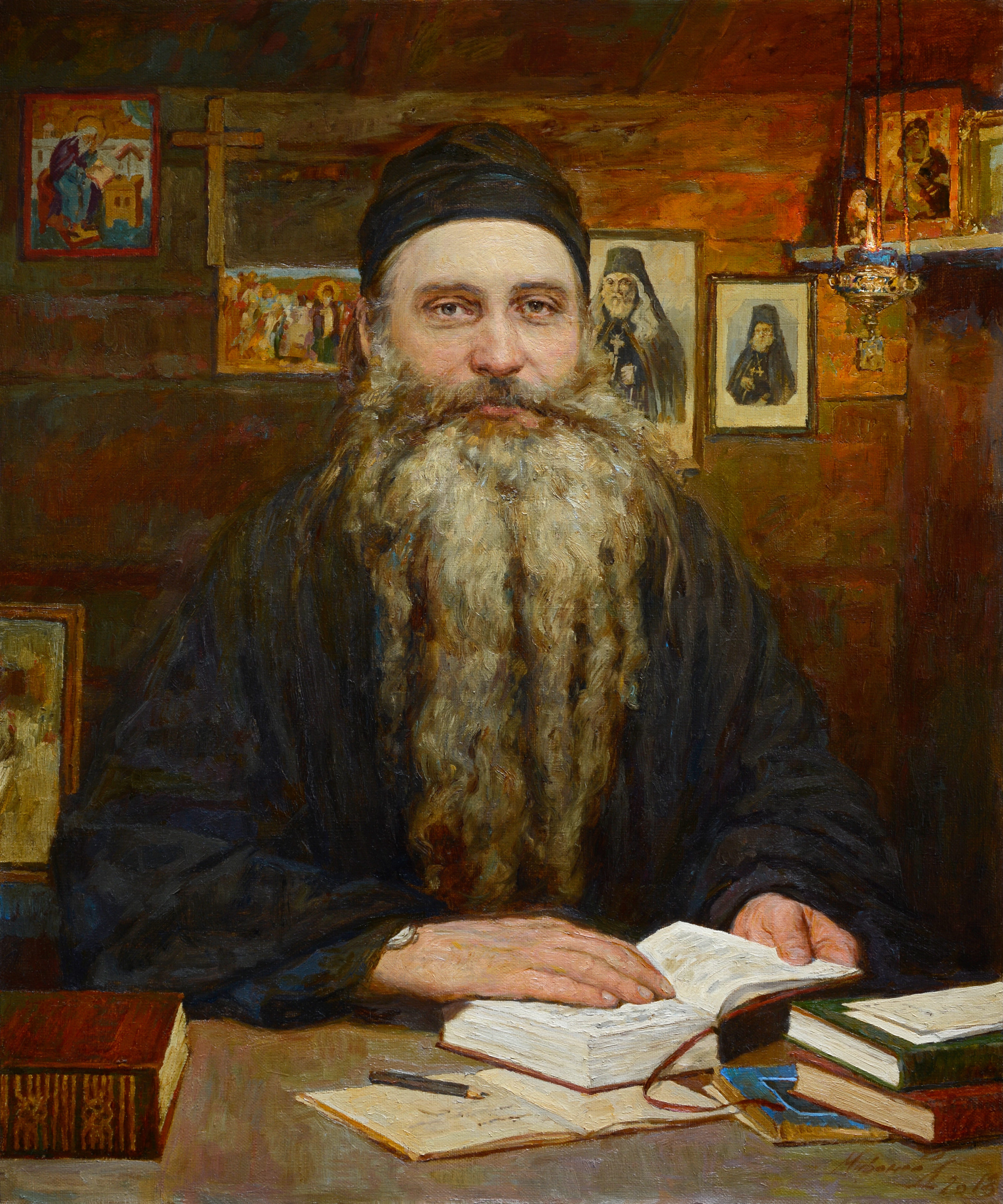
Father Rose, who is currently up for canonization as a saint, walks readers along some totally breathtaking lines of argument in chapter 6 of his 1975 book Orthodoxy and the Religion of the Future, “Signs from Heaven: An Orthodox Christian Understanding of Unidentified Flying Objects.” Personally I’d make the man a saint just for that title alone, but I’m not a patriarch of the Church. Rose’s claims are:
Science fiction is our modern mythology, and its dominant storylines tend to depict mankind evolving up out of a materialist universe until we dissolve our individual personalities into a pantheistic super-consciousness (or, as Arthur C. Clarke called it in the 1953 classic Childhood’s End, an “Overmind”).
The most intense “Close Encounters” with alien craft reported in real life are profoundly distressing descriptions of experiences that line up closely both with the mystic materialism of science-fiction and with our many premodern tales of demons and sorcerers.
So, “UFO encounters are but a contemporary form of an occult phenomenon which has existed throughout the centuries.”
Because the language and imagery of Christianity no longer live close to people’s hearts, they no longer think to interpret the apparitions they see in spiritual terms. Instead they use pseudo-materialist frameworks that they get from sci-fi. But—and this is what really gets me—the underlying perceptions are the same, or at least very similar.
Rose quotes a passage from the biography of St. Nilus of Sora, a 15th-century Russian ascetic, about a boy who was abducted by “a certain strange man who seized him and carried him, as if on the wind, into an impenetrable forest, bringing him into a large room in his dwelling.” Naturally, St. Nilus and the boy interpreted the data of their experience as a demonic assault; if they had been Kentucky farmers in the 1970s, they might have interpreted much the same data to represent an alien landing.
In the years since Rose died, scientific conjecture about aliens has only made them sound more and more like the angels and demons of Christian theology. Cognitive scientist Donald Hoffman is given to postulating that there are innumerable forms of sentience which operate, disembodied, outside the bounds of our senses set by evolution.
I have absolutely no definitive pronouncements to make about any of this. If I had to throw my own speculations in the mix, I’d say we’re a little quick to jump in fear to the “it’s demons” option. The Christian tradition includes benevolent trans-dimensional consciousnesses as well as malicious ones. If there’s life on planes intersecting with ours, and if it does turn out to fit the classical profile assigned to “spirits of the air,” of some of it might still be friendly. Some of it might just be fondly messing with us, the way I tease my cat by shining lasers on the floor.
In seriousness, though, I do think it’s worth considering things like the following: during the famous Miracle of Fátima, tens of thousands of people reportedly saw the sun doing cartwheels in the sky. That was 1917. In the 1940s, people started telling UFO stories. In between, the two world wars helped solidify the widespread assumption that the world is made of dead stuff, and explanations are either physical or false.
I suspect interest in UAPs is growing precisely because those assumptions are now falling away. Steven Spielberg is probably not the philosopher who will help us get to the bottom of all this—though we’ll have lots to discuss on our next episode of Klavans on the Culture when the movie comes out. For now, we can already say that Spielberg’s lifelong wonderment at visits from outer space may finally be revealing itself for the sign of the times that it is.
In my book, Light of the Mind, Light of the World, I argued that science can’t interpret itself. The story we tell about what’s out there conditions the things we see, and can’t see, in even our most advanced observations. We may find that, once you whisk away the cloak of materialism, the world underneath still contains all the spooky entities and superhuman powers it always has—and the language we inherit from our faith traditions isn’t so bad for describing things as they are after all.
 | A guest post by
|
"Passport to Magonia: From Folklore to Flying Saucers," by computer scientist and astronomer Jacques Vallée, who was a contributor to Project Blue Book, draws similar conclusions as Father Rose concerning mythological themes that exist from man's beginnings. To conclude that myth derives from reality is not a logical leap. Furthermore, extra-dimensional evidence is found in the Bible - angels appearing and disappearing, Jesus ascending bodily into heaven, Eden, Hades/hell/Sheol/Tartarus, the bosom of Abraham, the third heaven. Just as in the prophets' visions and John's descriptions in Revelation - our senses that operate in this dimension are limited by inadequate capacity and vocabulary to communicate what they are allowed by God to observe from other dimensions. 1 Corinthians 2:9
A Christian Apologist interviewed by Eric Mataxas on Socrates in the City made an interesting observation: the increase in UAP sightings parallels precisely the increased involvement with Paranormal Activity. UAP sightings in Russia was at a great height at same time that the Russians were deeply involved with psychic and para normal research.